Quick Essentials
Esta página aún no está disponible en tu idioma.
Welcome! ආයුබෝවන්!
First, thanks for considering Sri Lanka as a destination for your travel plans! We are truly honored that you wish to visit the Pearl of the Indian Ocean (or ‘Teardrop of the Indian Ocean’ as some call it, but frowned upon by locals)
To begin your journey, this page covers the most important things to know before you arrive here. You’ll find quick answers to common questions about visas, money, transport, safety, and basic travel tips. We also have a quick checklist tool on this page.
Sri Lanka is generally an easy country to travel in, but knowing a few essentials in advance can save time and make your trip much smoother.
Is it safe to visit Sri Lanka now?
Section titled “Is it safe to visit Sri Lanka now?”Travel Safety Status
Current safety status: Safe to visit. Safety score 90 out of 100. Last updated March 30, 2026.Safe to visit (90%)
Updated March 30, 2026Travel Conditions
Current travel conditions: Warning. Regional conflicts in Iran are causing flight delays and rerouting. Most local destinations remain open. Expect price hikes, fuel queues due to ongoing fuel shortages and weekly quotas.Regional conflicts in Iran are causing flight delays and rerouting. Most local destinations remain open. Expect price hikes, fuel queues due to ongoing fuel shortages and weekly quotas.
Obtaining Visa and/or ETA
Section titled “Obtaining Visa and/or ETA”Most travelers visiting Sri Lanka need an Electronic Travel Authorization (ETA) before arriving. (On-arrival is also possible for some nationals, but fees and regulations may vary.) This is a simple online approval that allows short tourist visits.
For tourism, the ETA usually grants a 30-day stay and can be extended up to 6 months. Once approved, the authorization is linked to your passport electronically. Make sure that you have a passport valid for not less than 6 months from the date of arrival.
When entering Sri Lanka, immigration officers may ask for:
- A return or onward ticket
- Proof of sufficient funds for your stay
- Proof of accommodation arrangements
Always confirm via following sites: Visa-free entry applies to certain nationalities (India, Malaysia, etc.) for Sri Lanka. In such cases, you may not need to obtain an ETA. Additionally, refer to your government’s travel advisory for important information and safety guidelines while traveling.
How to Apply:
- Visit official site: https://eta.gov.lk
- Carefully read posted updates/news & the procedure.
- Fill application (5-10 minutes)
- Pay by credit/debit card
- Receive the acknowledgement
- Receive ETA via email (print or save on phone)
Best Time to Visit
Section titled “Best Time to Visit”Sri Lanka has a tropical climate and can be visited year-round. However, the island experiences two monsoon seasons that affect different parts of the country at different times.
This means that while one region may be rainy, another part of the island is usually sunny and ideal for travel. Understanding these seasonal patterns can help you choose the best time for the areas you plan to visit.
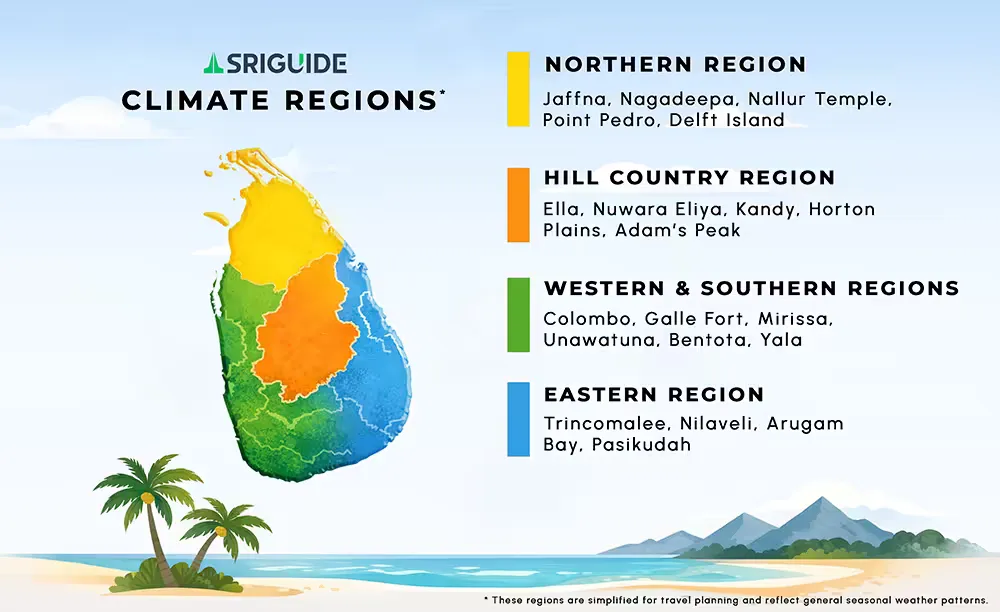
Generally, December to April is considered as the ideal time frame for visits in every region. You can find more details regarding each region below.
Northern Region
Best: May – September
Avoid: October – January (heavier rains)
Warm and mostly dry during mid-year. Temperature levels: 29-33°C (84.2-91.4°F)
Hill Country Region
Best: January – April (light rain and mist)
Avoid: May – November (frequent rain and mist)
Cooler climate due to higher elevation (~6000ft/1800m). Weather can change quickly. Temperature levels: 9-23°C (48.2-73.4°F). Night temperature can drop below 9°C in certain areas and times.
Western & Southern Regions
Best: December – March
Avoid: May – September (Southwest monsoon)
Sunny beaches and calmer seas during the dry season. Temperature levels: 28-32°C (82.4-89.6°F)
Eastern Region
Best: May – September
Avoid: October – January (Northeast monsoon)
Excellent beach weather and calm seas during mid-year.
Currency & Money
Section titled “Currency & Money”The currency of Sri Lanka is the Sri Lankan Rupee, abbreviated as LKR (or SLR in some cases).
The following tool will help you convert your currency into LKR easily.
Please note that the conversion rates are not in real time and are updated only every 24 hours.
Get to know the notes and coins
Current notes circulate in denominations of LKR 20, 50, 100, 500, 1000, 2000, and 5000, each showcasing landmarks, wildlife, and historical figures.
Coins come in LKR 1, 2, 5, 10, and 20 (rare) often featuring national symbols like the lion emblem.
Daily Budget Estimates Your input needed
Section titled “Daily Budget Estimates ”These figures reflect typical costs for different lifestyles, from street eats and buses to restaurant dining and tuk-tuks. Use this grid as a practical reference for your trip budgeting. Also you may want to add entry fees to attractions ($5-30), activities (safaris $30-80), beverages etc.
Accommodation: LKR 2000 - 4000 ($7-15) - guesthouses, hostels Food:
LKR 1500 - 2500 ($5-8) - local restaurants, street food Transport: LKR
1000 - 2000 ($3-7) - buses, trains, short tuk-tuks Total: ~$20-30 per day
Accommodation: LKR 8000 - 15000 ($25-50) - nice guesthouses, small
hotels Food: LKR 3000 - 5000 ($10-15) - mix of local and tourist
restaurants Transport: LKR 2000 - 5000 ($7-15) - private drivers, PickMe
rides Total: ~$50-80 per day
Accommodation: LKR 20000+ ($60+) - boutique hotels, resorts Food:
LKR 5000 - 10000 ($15-30) - hotels, upscale dining Transport: LKR 10000+
($30+) - private car with driver Total: ~$120+ per day
SIM Cards & Internet
Section titled “SIM Cards & Internet”There are 3 active telecommunication providers in Sri Lanka: Dialog Axiata, SLT Mobitel, and Hutch.
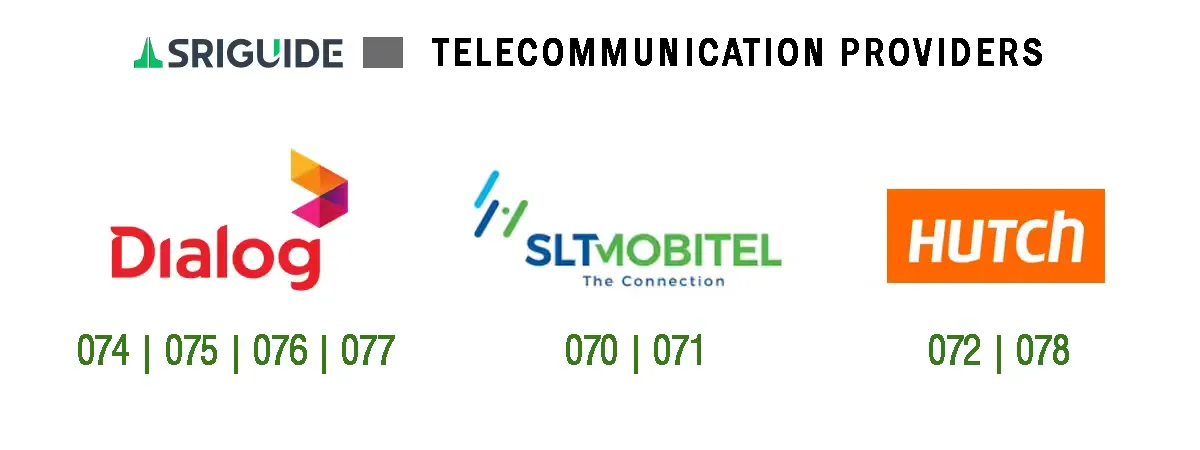
Your best and easiest option is to buy a SIM/eSIM at Bandaranaike International Airport (Colombo) by presenting your passport. There are plans specifically designed for foreigners that usually offer 10-50 GB mobile data packages. You can check the prices and any available offers at the counters. The cost of the packages varies between LKR 800 and 5000 (2-15 USD).
Coverage Ratings:
- Dialog (slightly better coverage than others)
- Mobitel (good coverage)
- Hutch (lacks coverage in rural areas)
WiFi Availability
Section titled “WiFi Availability”Most hotels and guesthouses offer free WiFi. However, many low to mid-range accommodations may impose speed limits or data caps, which can affect your connection speed and reliability. It’s always a good idea to keep a data package activated on your mobile plan.
Clothing Tips
Section titled “Clothing Tips”Temple-Appropriate Attire
Section titled “Temple-Appropriate Attire”- Cover shoulders (no tank tops)
- Cover knees (long pants, skirts, dresses)
- Remove shoes before entering temples
- Keep modest clothing in daypack for impromptu temple visits
Beach vs. Cultural Sites
Section titled “Beach vs. Cultural Sites”- Beaches: Swimwear okay, but avoid walking through towns in bikini/swim trunks
- Cities: Dress modestly, especially for women
- Hill country: Bring light jacket or sweater (cooler temps)
Time Zone
Section titled “Time Zone”Sri Lanka Standard Time: UTC +5:30 - No daylight saving time. The following widget will show you the current time in Sri Lanka and how many hours you are ahead of or behind it.
Language
Section titled “Language”◆ Official: Sinhala, Tamil
◆ Widely spoken: English (especially in tourist areas, hotels, restaurants)
In tourist areas of Sri Lanka, most tuk-tuk drivers and shop owners speak basic English. However, in rural areas, English is less common. Learning a few phrases in Sinhala can be very helpful. It shows respect for the local culture and can enhance your interactions with the community.
Useful Phrases
Section titled “Useful Phrases”Common phrases like ‘hello, yes, no, sorry, excuse me, good morning’ can be used as they are, since almost anyone will understand these terms. The following phrases will be important for managing the most common scenarios that may arise. Click the audio icon next to each phrase to listen to how it’s spoken.
Greetings
Section titled “Greetings”- Hello (Welcome!) - ආයුබෝවන්
āyubōvan - Thank you - ස්තූතියි
stūtiyi - Thank you very much - බොහොම ස්තූතියි
bohoma stūtiyi - How are you? - කොහොමද?
kohomada
Wayfinding
Section titled “Wayfinding”- This - මේක
mēka - That - අරක
araka - Where? - කොහේද?
kohēda? - When? - කවදද?
kavadada? - At what time? - කීයටද?
kīyaṭada? - How much is the fare? - ගාන කීයද? / කීයද?
gāna kīyada?
Shopping
Section titled “Shopping”- [Asking Price] How much? - ගාන කීයද?/ කීයද?
gāna kīyada? - [Asking Price] How much is this? - මේක කීයද?
mēka kīyada? - It’s too much [expensive] - ගාන වැඩියි
gāna væḍiyi - Can you reduce the price? - ගාන අඩු කරන්න පුලුවන්ද?
gāna aḍu karanna puluvanda? - I want this - මේක ඕන
mēka ōna - I don’t want this - මේක එපා
mēka epā
Dining
Section titled “Dining”- This is tasty - රසයි
rasayi - Is this too spicy? - මේක සැරද?
mēka særada? - I’d like it not too spicy - වැඩිය සැර එපා
væḍiya særa epā - Water - වතුර
vatura
Emergency
Section titled “Emergency”- Help (me) - උදව් කරන්න
udav karanna - I’m lost - මම අතරමං වෙලා
mama ataramaṁ velā
Power & Electricity
Section titled “Power & Electricity”In Sri Lanka, most power sockets are Type G, as this is the currently accepted standard. However, a few older socket types (Type D and Type M) are also in use, especially in older buildings and rural areas. You may need to carry a power adapter to plug into these sockets.
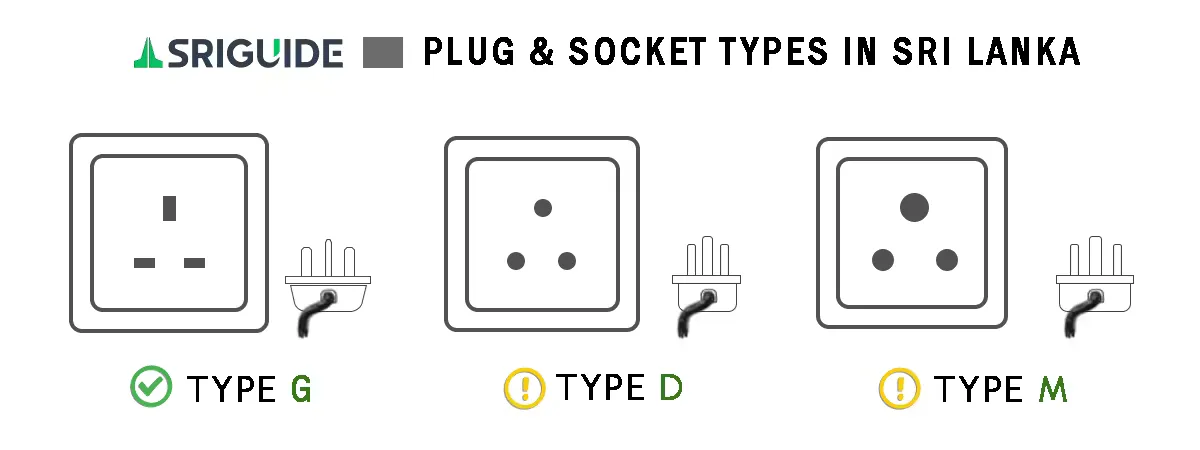
- Voltage: 230V, 50-60Hz
- Plugs: Type G (6A/13A), Type D (5A), Type M (15A)
- Power cuts: Occasional, especially during monsoon
Essential Apps & Extra
Section titled “Essential Apps & Extra”A few mobile apps can make traveling in Sri Lanka much easier — from booking taxis to navigating cities and finding places to eat. Before your trip, consider installing a few helpful apps for transport, maps, and local services. See the full list of recommended travel apps and more on here.
Packing Essentials
Section titled “Packing Essentials”Here you’ll find everything you need to pack for your Sri Lanka adventure. Make it your own, add/edit/delete - everything will be saved locally!
What NOT to Pack
Section titled “What NOT to Pack”- Heavy clothes (it’s HOT year-round except hill country)
- Too much cash (ATMs everywhere)
- Expensive jewelry (leave valuables at home)
All Packed Up?
Section titled “All Packed Up?”All set to explore Sri Lanka? Run through this quick checklist before you go. You can edit/add items too! And don’t worry, nothing leaves your device - everything is safely stored in your local storage. Check out the whole travel toolkit here.
- Passport (valid for at least 6 months)
- Visa / ETA approval confirmation
- Return or onward flight ticket
- Travel insurance documents
- Hotel or accommodation confirmation
- Credit or debit cards
- Some cash for arrival
- Power adapter
- Lightweight clothing for tropical weather
- Comfortable walking shoes or sandals
- Sunscreen and sunglasses
- Medications, prescriptions
- Phone charger, power bank
- Copies of important documents (digital or printed)
- Mosquito repellent
- Empty reusable water bottle (if needed)
- Small backpack
- Toothbrush, sanitary products
Nice-to-Have
Section titled “Nice-to-Have”- Flashlight/headlamp (power cuts can happen)
- Small backpack for day trips
- Sarong (multi-use: beach, temple cover-up, towel)
- Basic first-aid kit
- Tissues/toilet paper (not always available)
- Ziploc bags (protect electronics from humidity)
- Book or Kindle (for long train rides)
What to Do After Landing?
Section titled “What to Do After Landing?”Here’s what to do after landing in Sri Lanka…
- Check local time and adjust devices
- Complete immigration and passport control
- Collect luggage
- Buy a local SIM/eSIM
- Exchange money to Sri Lankan Rupees (LKR)
- Withdraw cash from an ATM (if needed)
- Check weather on destination
- Arrange airport transport
- Confirm hotel check-in details
- Eat, drink and rest!
Airport to Colombo/Negombo:
Section titled “Airport to Colombo/Negombo:”- PickMe/Uber: ~LKR 1,500-2,000 to Negombo (15-20 min), ~LKR 2,500-3,500 to Colombo (45 min)
- Prepaid taxi: Available at counter, slightly more expensive
- Bus: Cheapest (~LKR 150-250) but not convenient with luggage
See our Getting Around guide for detailed transport info.
Quick Safety Tips
Section titled “Quick Safety Tips”- Save 1912 (Tourist Police) in your phone
- Don’t drink tap water
- Agree on tuk-tuk price BEFORE getting in
- Modest dress for temples
- Keep small bills for daily transactions
See our Safety & Health page for comprehensive safety info.
Dial the following number to connect with Tourism Police Division, obtain travel information and emergency help in an unexpected disaster.
Verify: Entry requirements change frequently. Always check official eta.gov.lk before booking your trip.
© 2026 SriGuide - Free & Open Source
Project by